Japan by Car: Best Road Trips and Driving Routes for JDM Fans
The best driving routes in Japan for JDM fans, from Hakone and Mount Fuji to the Wangan and Daikoku PA, with tolls, ETC, parking, mileage limits and which car to rent for each.
Japan has one of the best rail networks in the world, so most first-time visitors do not need a car for their entire trip.
If you are into Japanese cars, though, driving opens up a different version of the country. You can:
- drive a GT-R towards Mount Fuji;
- take a Supra or GR86 through Hakone;
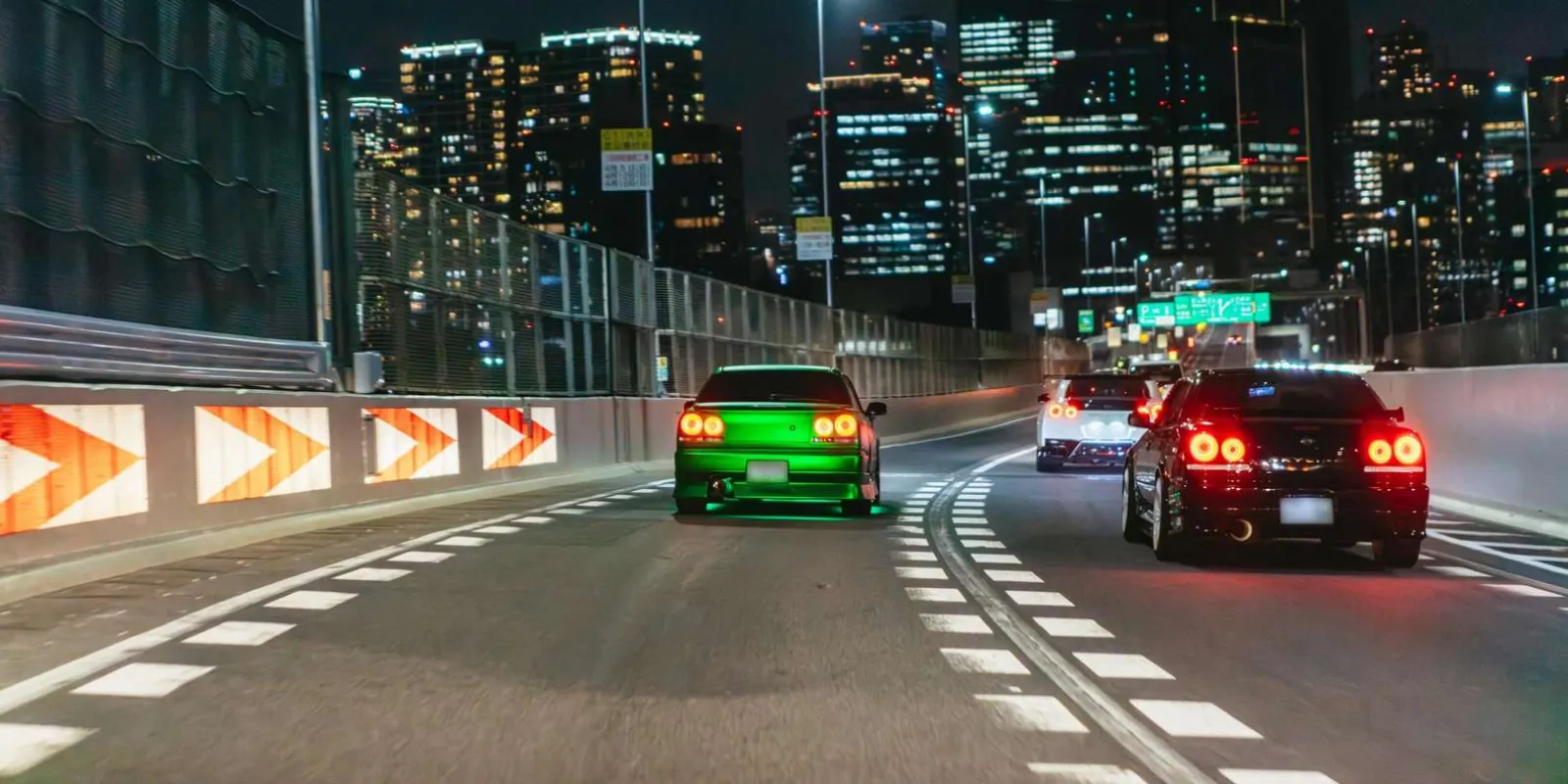
- cruise Tokyo’s elevated expressways at night;
- arrive at Daikoku PA in your own JDM rental;
- explore mountain and coastal roads that are awkward by train;
- visit automotive locations at your own pace.
The mistake is assuming:
Japan by car = rent a car for two weeks and drive everywhere.
For most visitors, the better strategy is:
use trains inside the major cities, then rent a car for the parts of the trip where driving improves the experience.
Check Availability
Japan by car at a glance
| Question | Answer |
|---|---|
| Do you need a car in Tokyo? | Usually no |
| Is driving in Japan worth it? | Yes, especially outside cities |
| Best drive from Tokyo for JDM fans | Hakone + Yokohama + Daikoku |
| Best scenic drive near Tokyo | Hakone / Fuji area |
| Best urban JDM drive | Tokyo Bay + Wangan + Daikoku |
| Best car for a long road trip | Normal rental or modern sports car |
| Best use of an R34/RX-7 rental | Dedicated one-day experience |
| Are expressways free? | No |
| Should you get ETC? | Yes, if available |
| Which side does Japan drive on? | Left |
| Is an IDP usually required? | Yes, for most tourists |
Is Japan good for a road trip?
Absolutely, though not everywhere for the same reason.
Japan combines well-kept roads, mountain scenery, coastal routes, an extensive expressway network, excellent service areas and an extraordinary car culture. Outside the major cities, a car also makes rural destinations much easier to reach.
For a JDM fan there is one more benefit: the drive itself can become an attraction.
Should you rent a car for the entire Japan trip?
Usually, no.
If your itinerary is simply Tokyo → Kyoto → Osaka, a car often creates more problems than it solves: tolls, fuel, city traffic and hotel parking.
Use the Shinkansen between the big cities. Rent a car for the dedicated driving day or the rural region.
Best JDM road trip from Tokyo: Hakone → Yokohama → Daikoku
If we had one full driving day, this is the route we would consider first.
Morning
Collect the JDM rental and leave Tokyo.
Late morning / afternoon
Drive towards Hakone for mountain scenery and roads that give you a reason to have rented a sports car.
Late afternoon
Head towards Yokohama to rest and eat.
Evening
Join the expressway network towards Daikoku PA.
Night
Return to Tokyo.
That gives you mountain driving + a Japanese performance car + a JDM meet in one day. For how Daikoku works once you arrive, and what to do if it is closed, see our Daikoku PA car meet guide.
The best driving routes, one by one
1. Hakone — best overall drive from Tokyo
Hakone is close enough for a day trip but feels completely different from the city. You get mountain roads, changes in elevation, Lake Ashi, Fuji views when the weather cooperates, and weekend enthusiast traffic.
Roads to look at include the Hakone Turnpike, the Hakone Skyline and the Ashinoko Skyline. All three are toll roads, and all three are public roads with ordinary traffic.
Best cars for Hakone. You do not need maximum horsepower. A GR86, MX-5, S2000, Evo, WRX, Supra or RX-7 can be more enjoyable on ordinary roads than a car with huge power.
2. Fuji Five Lakes — best scenic drive
If your ideal photograph is:
Japanese sports car + Mount Fuji
consider Fuji Five Lakes. The draw is scenery, photography and the feeling of a road trip.
Fuji is weather-dependent, though. Do not pay a large specialist-car premium solely for one planned photograph.
3. Tokyo Bay, Wangan and Yokohama — best shorter JDM drive
A shorter itinerary could be:
Tokyo → Rainbow Bridge → Tokyo Bay → Bayshore/Wangan → Yokohama → Daikoku → Tokyo
That gives you much of the Tokyo Drift and Wangan atmosphere without using up a large mileage allowance. It suits seven-hour rentals and visitors whose main goal is Daikoku.
4. Daikoku PA — best ending to a driving day
Treat Daikoku as the end of a driving experience, not the entire reason for renting the car.
A day of Hakone and Yokohama that ends at Daikoku makes far better use of an expensive R34 or GT-R than a direct run out from central Tokyo.
5. Izu Peninsula — best longer road trip from Tokyo
Izu offers coast, mountain roads, onsen towns and a slower road-trip pace.
For several days, consider switching from a valuable specialist car to a comfortable normal rental. A modified RX-7 with stiff suspension and expensive excess mileage may be wonderful for six hours and much less so for three days of luggage and hotels.
6. Gunma — best for Initial D fans
Gunma contains the real mountain areas associated with the setting that inspired Initial D, particularly around Haruna and Ikaho, and Akagi.
Visit for the locations and the roads. Public mountain routes are not drift courses.
A GR86, MX-5 or a similar driver’s car may fit this trip better than a high-powered GT-R.
7. Nikko — best sightseeing and driving combination
Nikko works well if you are travelling with someone who does not want every day to revolve around cars. It combines scenic roads, lakes and mountains with major temples and shrines.
A normal or comfortable performance rental can make more sense here than a hardcore modified classic.
8. Hokkaido — best for a proper multi-day road trip
If you want to explore Japan by car over several days, Hokkaido is one of the strongest regions. Distances are large, and a car opens up remote landscapes, national parks, smaller towns and scenic routes.
This is where a practical normal rental often makes far more sense than an R34.
JDM car or normal rental?
Choose a specialist JDM rental if:
- the car itself is the attraction;
- you are renting for one dedicated day;
- you want an R34, GT-R, Supra or RX-7;
- you have little luggage.
Choose a normal rental if:
- you are travelling for several days;
- you are carrying luggage;
- you are covering hundreds of kilometres;
- you are visiting rural regions;
- comfort and fuel economy matter.
Choose a modern JDM performance car if:
You want a compromise between excitement and practicality. A GR86, GR Supra, modern Type R, WRX or R35 can be a much easier companion than a heavily modified 1990s classic.
Why not take an FD RX-7 across Japan?
Because a car that is exciting for one day can become exhausting as transport.
A specialist FD may come with a manual gearbox, little luggage room, stiff suspension, expensive mileage, a large deposit, higher fuel use and classic-car worries.
For Tokyo → Hakone → Daikoku, that is part of the fun. For Tokyo → Kyoto → Hiroshima → Fukuoka, it may become unnecessary stress. Our Mazda RX-7 rental guide covers what the FD3S market looks like in Tokyo.
Costs and practicalities
Mileage limits are the hidden problem
Specialist performance cars may include only 200–250 km a day. That is fine for Tokyo, Yokohama and Daikoku, but it can become restrictive for Fuji, Izu or cross-country travel.
Build the route before choosing the car. Our JDM car rental prices guide sets out what excess mileage, deposits and insurance add to the daily rate.
How expensive are Japanese expressways?
Japan’s major expressways are toll roads, and a long intercity drive can add substantial tolls before fuel and parking.
That is why driving Tokyo → Kyoto to save money is often less compelling than taking the train. A car makes more sense when several people share it, when you want rural stops, or when the journey itself is the point.
What is ETC and should tourists use it?
ETC is Japan’s electronic toll collection system. With an ETC-equipped rental and card, tolls are much easier.
It matters especially around Tokyo, because more expressway entrances are becoming ETC-only. For Wangan and Daikoku driving, request ETC if the rental company offers it.
Can you pay without ETC?
On many conventional expressways, yes, but it is increasingly inconvenient around Tokyo.
For a foreign driver already learning road signs and junctions, there is little benefit in making toll payment harder too.
Service areas are part of the experience
Japanese motorway service and parking areas can offer restaurants, regional food, convenience stores, toilets, fuel, souvenirs and views.
Daikoku itself is one of these facilities. The world-famous JDM gathering happens in a place whose official purpose is serving motorway users.
Parking: why not drive everywhere
Japan’s public transport means a car can become a burden in the major cities. If your itinerary is mostly central-Tokyo sightseeing, use the train, and save the car for the driving day.
Rules of the road
Do you need an IDP?
For most foreign tourists, yes.
Japan generally uses the qualifying 1949 Geneva Convention IDP route, with a separate authorised-translation system for licences from certain countries. Our guide to whether tourists can drive JDM cars in Japan explains both routes and what rental companies ask for on top.
Which side of the road?
Japan drives on the left, and domestic cars are normally right-hand drive. Visitors from countries that drive on the right may need time to adjust.
Is driving difficult?
Usually less chaotic than many visitors expect. The challenge is unfamiliarity: left-side traffic, road signs, narrow streets, bicycles, pedestrians, expressway exits and parking.
Central Tokyo is not where we would choose to learn all of that in a valuable manual R34.
Winter driving
Snowy regions need proper winter equipment and much more planning. We would rarely choose a classic JDM performance car for genuinely snowy conditions. Pick a vehicle and tyres suited to the weather.
When to go, and for how long
Best season for a JDM road trip
Spring. Comfortable overall.
Summer. Beautiful, but hot, humid and sometimes very wet.
Autumn. Probably our favourite, for milder temperatures and autumn colour in the mountains around Hakone and Nikko, though September can still bring typhoons.
Winter. Potentially spectacular, but it needs route and tyre planning.
Is Japan good for family road trips?
Yes, but separate the road-trip rental from the JDM experience rental. Use a practical family car for the multi-day journey, and book the RX-7 or R34 experience separately.
How many days do you need?
One day. Perfect for Tokyo → Hakone → Yokohama → Daikoku.
Two days. Add Fuji, or Izu with an overnight stay.
Three to five days. Choose a wider regional road trip.
One week or more. Choose a region instead of trying to drive the whole country.
Is Tokyo to Kyoto a good road trip?
It can be, but for most first-timers the Shinkansen is easier. Driving makes sense when the route between the cities is itself the point.
Best JDM car for a Japan road trip
R35 GT-R
Modern, automatic and powerful, but expensive and fuel-hungry.
GR Supra
One of our favourites: modern, fast and easier than a classic. Our Toyota Supra rental guide compares it with the A80.
GR86
Possibly the smartest choice for someone who mainly wants to drive.
R34 Skyline
Best if driving an R34 is the entire reason for the day.
R34 GT-R
A bucket-list rental: better for one memorable day than as long-term transport. Our Nissan GT-R rental guide separates the genuine GT-R from the other R34 Skylines.
RX-7 FD
An extraordinary experience, and much less convincing as practical long-distance transport.
One-day JDM itinerary
08:00–09:00
Collect the car and go through the controls, ETC, fuel and return conditions.
09:00–11:00
Leave Tokyo towards Hakone.
11:00–15:00
Hakone: scenery, lunch and photos.
15:00–17:00
Head towards Yokohama.
17:00–19:00
Food and rest.
Evening
Daikoku PA, if conditions and the rental return time allow.
Night
Return to Tokyo.
Important: check the return time
A “one-day rental” does not necessarily mean returning the car at midnight. Some specialist operators use fixed daytime windows.
If your car must be back at 18:00, it is not suitable for the classic Friday-night Daikoku plan.
10 mistakes to avoid
- Renting a car for central-Tokyo sightseeing.
- Taking an expensive classic on a huge cross-country trip without checking the mileage allowance.
- Forgetting ETC.
- Assuming expressways are free.
- Ignoring parking costs.
- Choosing a car on fame alone.
- Trying to learn manual in an RX-7.
- Planning snowy mountain roads without proper equipment.
- Treating public mountain roads as drift courses.
- Making Daikoku the only objective.
Do you need to drive to experience JDM culture?
No. You can still take JDM tours and Daikoku tours, visit A-PIT, NISMO and the Nissan galleries, go to Tokyo Auto Salon, and book model-specific passenger experiences.
If the mountain roads are the draw but you can’t rent, or would rather not, the Private JDM Sports Car Tour to Mt Fuji and Hakone (5.0/5 from 19 reviews, from $426) drives you there in a car you choose, with pickup in Tokyo. Its own conditions state that the experience does not include any driving by the customer. The Mt. Fuji Skyline JDM Car Driving Tour (5.0/5 from 9 reviews, from $252) is chauffeured too, despite its name; with only nine reviews it has a thin track record so far.
For the Nissan side, the JDM Tour with GT-R, NISMO Factory & Daikoku PA (4.7/5 from 30 reviews, from $475) puts the NISMO office on the itinerary before Daikoku. And for an evening at the meet without a rental, the Tokyo JDM Tour: Daikoku PA, Skyline GT-R & RX-7 (4.7/5 from 1,310 reviews, from $102) rides out in modified performance cars via A-PIT Autobacs.
Driving becomes worthwhile when the steering wheel is part of the dream. Our JDM tour vs JDM car rental comparison helps you decide which side of that line you are on.
Our ideal first-time strategy
For a two-week first trip to Japan:
Tokyo
Use trains for normal sightseeing.
One JDM evening
Take a JDM tour and experience Daikoku.
One dedicated driving day
Rent the R34, GT-R, Supra, RX-7 or another driver’s car. Drive Hakone → Yokohama → Daikoku if timing allows.
Kyoto / Osaka
Travel by train.
Rural extension
Rent a normal car locally if it helps.
That gives you the JDM experience without paying specialist-car prices while your R34 sits in a city hotel garage.
Is exploring Japan by car worth it for a JDM fan?
Yes, very much so.
Use trains where they are better, and cars where they give you something the railways cannot: mountain roads, remote scenery, flexible rural travel, Tokyo’s expressways, Daikoku, and the experience of driving a Japanese performance car in Japan.
For one car-focused day, our choice is:
Tokyo → Hakone → Yokohama → Daikoku PA
in whichever JDM car you have always wanted to drive.
Continue planning
JDM car rental in Tokyo compares the fleets car by car, and JDM car rental prices shows what a driving day costs once the deposit, mileage and tolls are added. Before you book anything, can tourists drive JDM cars in Japan? checks your permit. JDM tour vs JDM car rental helps if you are still deciding whether to drive, and the Daikoku PA car meet guide covers the place most driving days end.
Frequently asked questions
Do you need a car to visit Japan? Usually not. Japan’s rail network handles the major cities better than a car does. Rent one for a dedicated driving day or a rural region, where it adds something the trains cannot.
What is the best driving route from Tokyo for JDM fans? Tokyo to Hakone, then Yokohama, then Daikoku PA in the evening. It combines mountain roads, a Japanese performance car and Tokyo’s best-known car meet in a single day.
Are Japanese expressways free? No. Japan’s major expressways are toll roads. An ETC card makes paying much easier, and some Tokyo expressway entrances now accept ETC only.
Do tourists need an International Driving Permit to drive in Japan? Most do. Japan recognises the 1949 Geneva Convention International Driving Permit, carried with your original licence and passport. Drivers with licences from a few countries use an authorised Japanese translation instead.
Which side of the road does Japan drive on? The left. Japanese domestic cars are normally right-hand drive.
Should I rent an R34 or RX-7 for a whole Japan road trip? Usually not. Specialist cars often include only 200 to 250 km a day, carry large deposits and have little luggage room. Rent one for a single dedicated day and use a normal rental for longer trips.
How many days do you need for a JDM road trip in Japan? One day covers Tokyo, Hakone, Yokohama and Daikoku PA. Two days lets you add Fuji or Izu, and a week or more is best spent on one region, not the whole country.
Would you rather ride than drive? See the Tokyo JDM tours that put you in a real tuned car with a local driver, and check live availability for your dates.
Ride Tokyo's JDM Scene Tonight
Join 5,500+ riders who rated this experience 4.8/5. A seat in a real tuned JDM car, entry to Daikoku PA's legendary meet, and a guide who lives the scene — free hotel drop-off included.
Check Availability & Book