Daikoku PA vs Tatsumi PA
Compare Daikoku PA and Tatsumi PA for JDM cars, atmosphere, photography, access and car-meet reliability, and see which one to prioritise in Tokyo.
If you are planning a Tokyo JDM trip, two names appear again and again: Daikoku PA and Tatsumi PA. Both are expressway parking areas tied to Japan’s night-driving culture, and both can attract GT-Rs, RX-7s, Supras, Silvias, Evos, Porsches and other enthusiast cars.
But they are not interchangeable, and choosing between them on reputation alone is how people end up disappointed. Daikoku is much larger, far better known internationally, and much more likely to deliver the substantial car gathering most first-time visitors are imagining. Tatsumi is smaller, more transient, and much more closely tied to the feeling of driving Tokyo’s expressways themselves.
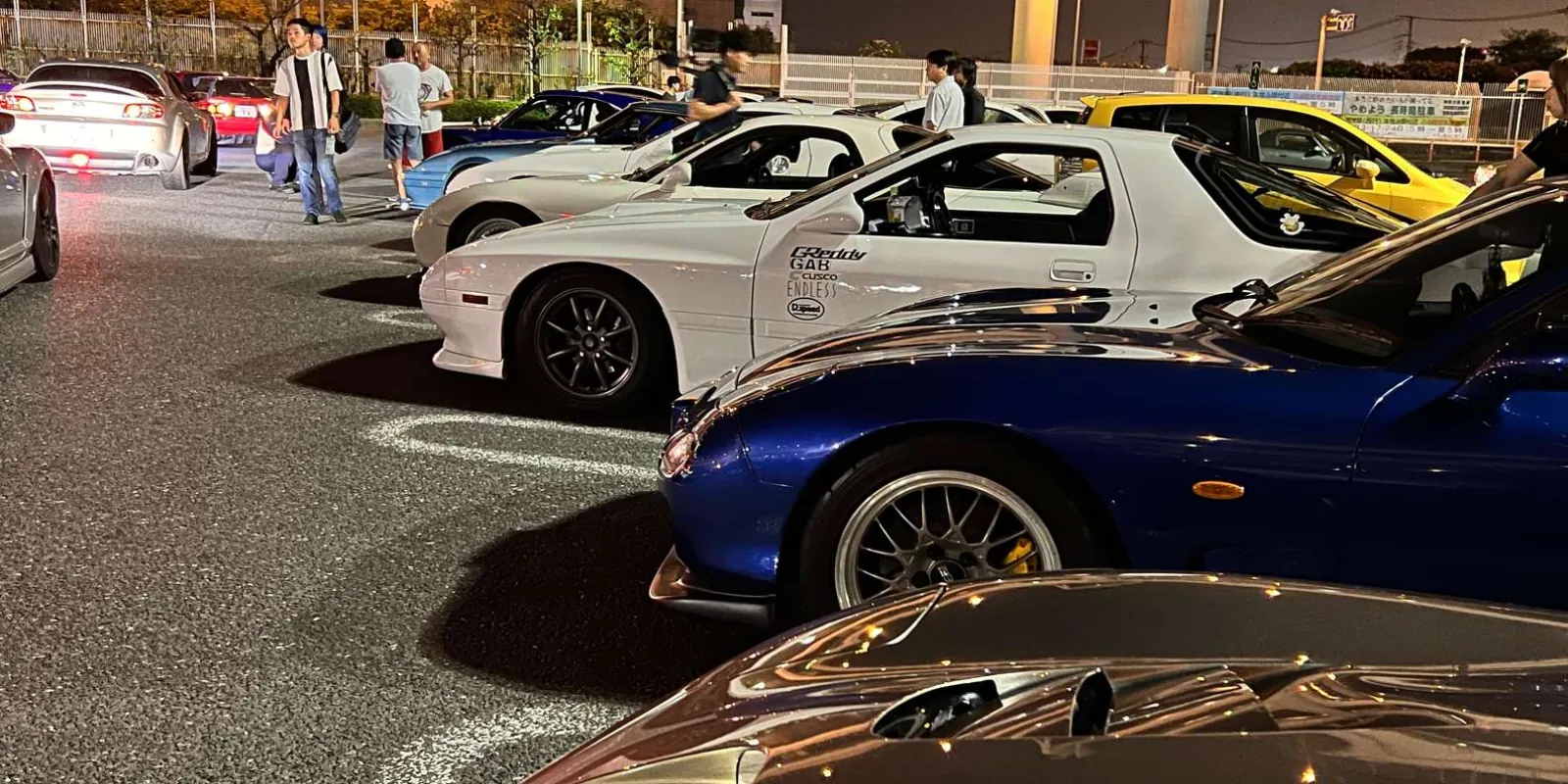
The short version: if you only have time for one, choose Daikoku PA. If you already have a car, or you are doing a wider JDM night drive, Tatsumi is an excellent additional stop.
Daikoku PA vs Tatsumi PA at a glance
| Daikoku PA | Tatsumi PA | |
|---|---|---|
| Location | Yokohama | Tokyo |
| Main appeal | Large informal car gathering | Small expressway and Wangan stop |
| Size | Very large | Very small |
| Standard-car spaces | 335 | No.1: 29; No.2: 22 |
| Chance of seeing many cars | Much higher | Lower |
| Car turnover | Medium | High |
| Best for a first-time visitor | Yes | No |
| Urban Tokyo atmosphere | Moderate | Better |
| Public transport access | No | No |
| Worth visiting on its own | Yes | Usually as part of a drive |
| Overall choice | Daikoku | Add-on |
Check Availability
What is Daikoku PA?
Daikoku is a large rest area inside the Shuto Expressway system in Yokohama, sitting under a distinctive circular ramp structure on the Daikoku-futo reclaimed island.
Its huge parking capacity gives it the one thing Tatsumi cannot reproduce: critical mass. Cars can arrive in groups and stay a while without immediately filling every space, which is what allows an informal gathering to become a genuine event rather than a series of brief stops.
That is the main reason Daikoku, rather than any of Tokyo’s own parking areas, became the destination international visitors fly in for. Our full guide to what Daikoku Parking Area is covers its history and why the scene settled there.
What is Tatsumi PA?
Tatsumi consists of two small parking areas within Tatsumi Junction on Tokyo’s Shuto Expressway, on the Wangan corridor between the city and Tokyo Bay.
The better-known Tatsumi No.1 has only around 29 standard-car spaces. That single figure reframes the entire experience. Instead of dozens or hundreds of cars settling into a broad parking area, what happens at Tatsumi is much closer to:
interesting cars stopping briefly during a Tokyo expressway drive.
It is a real part of the scene. It is simply a different kind of place from the one most people are picturing when they search for a Tokyo car meet.
Which has more JDM cars?
Daikoku — easily.
If your question is simply where am I more likely to see lots of interesting JDM cars, the answer is not close.
The clearest way to understand the gap is by scale rather than by reputation: at Tatsumi, 15 interesting cars can make the parking area feel busy. At Daikoku, 15 cars can feel like a quiet night.
Which has better cars?
There is no meaningful winner here. Either location can produce extraordinary cars on a given night.
The useful distinction is not quality but pattern. Daikoku gives you greater variety and volume in one place. Tatsumi gives you a smaller number of cars cycling through more quickly — you see fewer at any one moment, but the lineup keeps changing while you stand there.
Which feels more like a real car meet?
Daikoku feels more like a meet. Cars gather, people stay, and groups park together — that is the behaviour that makes a gathering rather than a car park.
Tatsumi feels more like Tokyo highway culture. Cars use it as a meeting point, a break, a photo stop or a pause during a wider drive.
Neither is more legitimate than the other. They are answers to different questions.
Which is better for Wangan Midnight fans?
Probably Tatsumi, for the expressway atmosphere — it sits on the Wangan corridor the manga and anime are built around, and it feels like the setting in a way a Yokohama service area does not.
But if what you actually want is a lot of R34s, RX-7s and Supras parked together in one place, Daikoku remains the safer choice even for a Wangan Midnight fan.
The compromise most readers want is a tour that drives the Wangan route and finishes at Daikoku. The JDM Scene Tour with Daikoku PA & Tokyo Tower — 4.9/5 from 302 reviews, from $121 — leads its own highlights with riding the Wangan highway made famous by the anime, then runs to Daikoku, which is exactly that trade made for you.
Which is better for Tokyo Drift fans?
Daikoku for the cars. Tatsumi for the urban expressway setting.
The ideal evening includes both, which is genuinely possible with a car or the right tour — see the itinerary further down. Our guide to Tokyo Drift and Fast & Furious car experiences separates the filming-location claims that hold up from the ones that do not.
Which is better for photography?
Daikoku is better for rows of cars, overpass structures and sheer variety. There is space to move around a car and get a clean angle on it.
Tatsumi offers an interesting urban atmosphere, but be aware that many of the iconic older skyline-photo angles associated with it are not as straightforward today, because the location and its surroundings have changed over time. Photographs circulating online are not all current.
For a first-time visitor with a camera, we choose Daikoku.
Is Daikoku more touristy?
Yes, considerably. Its global visibility through YouTube, TikTok, Instagram and commercial tours has grown enormously in the last few years, and a proportion of any given crowd is now there to film rather than to show a car.
Tatsumi’s small size makes it much less useful for mass tourism, so it sees far fewer visitors.
But fewer tourists does not automatically mean a better experience. A quiet Tatsumi is quiet, not exclusive.
Which is more authentic?
Both are authentic in the only sense that matters: they are real expressway facilities used by real motorists and real enthusiasts, with nobody organising anything.
Daikoku has become a major international car-culture destination on top of that. Tatsumi remains more of a transient pause within Tokyo’s driving environment. Neither has been staged for visitors, and neither owes you a good night.
Which is easier to access?
Neither is accessible the way a normal Tokyo attraction is. Both require vehicle access through the Shuto Expressway network, and both are effectively closed to anyone on foot.
With a tour, Daikoku is much easier, simply because there are far more visitor-oriented products built around it.
Can you take public transport to Tatsumi PA?
No.
The existence of a Tatsumi Station nearby does not make the parking area walkable — this is the single most common mistake we see about Tatsumi specifically, and it is entirely the name’s fault. You need vehicle access through the expressway.
The same applies to Daikoku, for the same reason. How to get to Daikoku PA without a car goes through every train, bus and taxi plan people attempt, and why each one runs into the same wall.
Which is better without a car?
Daikoku, because the tour infrastructure around it is much stronger. There are more than twenty bookable products that run to Daikoku, and a handful at most that touch Tatsumi.
Which is better with a rental car?
This is where Tatsumi becomes much more interesting.
A night with your own car could look like:
Tokyo → Tatsumi → Wangan / Tokyo Bay → Daikoku → Tokyo
At that point the two parking areas stop competing and start complementing one another — Tatsumi as the warm-up on the way out, Daikoku as the destination. JDM car rental in Tokyo covers the fleets, deposits and licence rules if that is the version of the night you want.
How long should you spend at each?
Daikoku: around 60–90 minutes for a good first visit.
Tatsumi: usually a short stop, often 15–30 minutes.
That contrast is the most useful single sentence on this page:
Daikoku is a destination. Tatsumi is a stop.
Which is more likely to close?
Both can be temporarily unavailable for maintenance, operational or security reasons.
Daikoku also faces crowd pressure on very busy nights, and can be closed to car traffic from around 8pm on a packed Friday or Saturday — our guide to the best time to visit Daikoku PA covers how to time an arrival around that.
Tatsumi has a different practical problem even when it is fully open: with 29 spaces, it can simply be full. A closure is not the only way a parking area can fail to let you in.
Which is better on a Friday or Saturday?
Daikoku. This is when we would actively plan to visit, accepting the crowd risk in exchange for the turnout.
Tatsumi. Interesting cars can appear, but we would not structure an entire evening around expecting a large meet there.
Weekend winner: Daikoku, by a large margin.
Which is better on a weekday?
The difference narrows, because both become unpredictable.
If you have your own car, check both if the route makes sense — a quiet Tatsumi costs you fifteen minutes. If you are paying for a tour, still choose a Daikoku-focused product, because a midweek Tatsumi is not something worth building a paid evening around.
Daikoku vs Tatsumi for different visitors
First-ever JDM trip: Daikoku.
Serious Wangan Midnight fan: both.
Photographer: Daikoku, if cars are the priority.
One evening in Tokyo without a car: a Daikoku tour.
JDM rental for a whole night: both, with Tatsumi as part of the drive and Daikoku as the main stop.
Tatsumi No.1 vs Tatsumi No.2
When enthusiasts simply say “Tatsumi PA”, they usually mean Tatsumi No.1 — the better-known of the two, with around 29 standard-car spaces against No.2’s 22.
The two serve different traffic flows and cannot be treated as two halves of one ordinary car park. Your expressway route determines which one you can actually reach, which is another reason Tatsumi rewards a driver who has planned the night rather than a visitor improvising.
Can you visit both on the same tour?
Sometimes — and this is worth checking rather than assuming, because the number of products that touch Tatsumi is small.
Two listings on this site name it. The JDM Car Meet, Autobacs & Daikoku Parking private tour is the only one that guarantees it, listing “access to Tatsumi and Daikoku Parking Areas” among its inclusions and stopping at Tatsumi for skyline views before continuing to Daikoku. It is a genuine match for the itinerary this page describes, but it has a single review so far and starts from $330 — a thin record at a high price next to the mainstream Daikoku tours — so we would book it only if Tatsumi specifically is the reason you are going.
The Daikoku JDM Car Meet & Night Car Culture Tour — 4.8/5 from 714 reviews, from $108 — is the better-reviewed route to the same outcome, but not a guaranteed one. Its hosts pick two or three spots on the night from Daikoku, Tatsumi, Umihotaru, A-PIT Autobacs and Gaienmae, and its booking notes say Friday and Saturday night tours skip Daikoku altogether. If Tatsumi is a bonus rather than the point, that is the one we would book.
Either way, routes change with traffic and access conditions. If both parking areas matter specifically, confirm the current itinerary with the operator before you book rather than after.
So is Tatsumi better than Daikoku?
For almost every first-time international visitor: no.
Daikoku gives you dramatically more space, better odds of a sizeable gathering, greater car variety and far more tour options. Tatsumi gives you something subtler — an inner-Tokyo location, expressway atmosphere, the Wangan association, and fast-changing cars.
Subtler is not worse. It is just not what someone flying in for one night is hoping to see.
Our recommendation
If you have one JDM evening: go to Daikoku PA.
If you have your own rental car, or a tour that naturally passes Tatsumi: add Tatsumi.
If you are a Wangan Midnight fan: try to experience both, in that order, on the same drive.
The easiest way to remember the difference is:
Daikoku is where you go for the meet. Tatsumi is where you stop during the drive.
Continue planning
Start with what Daikoku Parking Area actually is, then best time to visit Daikoku PA for which night to pick and when to arrive. Our Tatsumi PA car meet guide covers Tatsumi on its own: access, No.1 vs No.2, and the best nights. Tokyo car meets and where to see JDM cars maps Tatsumi, A-PIT Autobacs, Umihotaru and Hakone alongside Daikoku, and how to get to Daikoku PA without a car handles the access problem both parking areas share. If you would rather drive yourself, JDM car rental in Tokyo covers what that actually involves.
Frequently asked questions
Is Daikoku PA or Tatsumi PA better? Daikoku, for almost every first-time visitor. It has around 335 standard-car spaces against Tatsumi No.1’s 29, which means far more cars, more variety and much better odds on any given night. Tatsumi is better only if you specifically want inner-Tokyo expressway atmosphere and already have transport.
How big is Tatsumi PA compared with Daikoku PA? Tatsumi No.1 has roughly 29 standard-car spaces and Tatsumi No.2 around 22, against approximately 335 at Daikoku. That difference in scale is why Daikoku hosts a gathering and Tatsumi hosts a series of short stops.
Can you get to Tatsumi PA by train? No. Tatsumi Station exists nearby, but the parking area sits inside the Shuto Expressway network with no pedestrian access from local streets. The name is misleading, and this is the most common planning mistake made about Tatsumi.
Is Tatsumi PA worth visiting? Yes, if you have your own car or a tour that passes it, and you understand what it is. Expect a fifteen to thirty minute stop with a handful of interesting cars cycling through, not a large static meet. It is a good part of a night drive and a poor substitute for Daikoku.
Which is better for Wangan Midnight fans, Daikoku or Tatsumi? Tatsumi has the stronger claim on atmosphere, because it sits on the Wangan corridor the series is built around. But Daikoku still delivers far more of the cars, so the ideal answer is a Wangan drive that finishes at Daikoku rather than choosing between them.
Do any tours visit both Daikoku PA and Tatsumi PA? A small number. One private tour lists access to both parking areas among its inclusions and stops at Tatsumi before Daikoku, and one well-reviewed shared tour picks two or three spots on the night from a list that includes Tatsumi, although its Friday and Saturday night tours skip Daikoku. Routes change with traffic and access, so confirm the current itinerary before booking.
How long should you spend at Daikoku PA and Tatsumi PA? About 60 to 90 minutes at Daikoku for a first visit, and 15 to 30 minutes at Tatsumi. Daikoku is somewhere you stay; Tatsumi is somewhere you stop.
Is Tatsumi PA less touristy than Daikoku PA? Yes, substantially, because it is far too small to support tour traffic. That does not automatically make it a better experience, though — fewer visitors also usually means fewer cars.
Ready to see the meet for yourself? Compare the Tokyo JDM tours that run out to Daikoku PA and check live availability for your dates.
Ride Tokyo's JDM Scene Tonight
Join 5,500+ riders who rated this experience 4.8/5. A seat in a real tuned JDM car, entry to Daikoku PA's legendary meet, and a guide who lives the scene — free hotel drop-off included.
Check Availability & Book