Daikoku PA Car Meet: How to Visit
Planning to visit Daikoku PA? How to get there, when the car meet is busiest, what cars you might see, whether you need a tour and what to expect on the night.
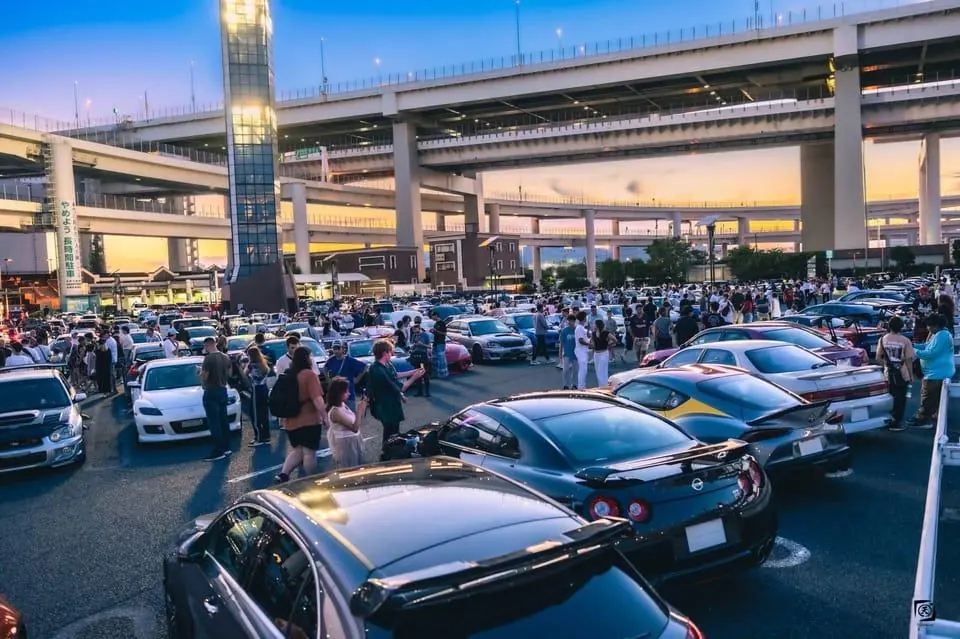
Daikoku Parking Area has become one of the most famous places in Japan for car enthusiasts — on the right night you’ll find rows of Nissan Skyline GT-Rs, Toyota Supras, Mazda RX-7s, Silvias, Honda NSXs, kei cars, exotic supercars and highly individual Japanese builds parked beneath a maze of elevated expressways. It’s also widely misunderstood. There’s no Daikoku car-meet timetable, no ticket, and no guarantee that dozens of modified cars will be waiting when you arrive.
Here are the short answers before the detail.
| Question | Short answer |
|---|---|
| Where is Daikoku PA? | Yokohama, south of central Tokyo |
| Is there an entrance ticket? | No |
| Is the car meet an official event? | No |
| Best nights for JDM cars? | Usually Friday and Saturday |
| Best time? | Evening — no start time is published |
| Can you reach it by train? | No |
| Can you walk there? | No practical or legal pedestrian access |
| Can tourists drive there? | Yes, if legally licensed to drive in Japan |
| Do you need a tour? | No, but it’s the easiest option without a rental car |
| Are GT-Rs / Supras / RX-7s guaranteed? | No |
| Can Daikoku close unexpectedly? | Yes |
Tour prices and departure dates change through the season, so it’s worth checking what’s actually running on your nights before you plan the rest of the evening around it.
Check Availability
What Daikoku PA actually is
Daikoku PA — short for Daikoku Parking Area — is a large rest area inside the Shuto Expressway network in Yokohama, and it is first and foremost a working Metropolitan Expressway rest stop, not an event venue.
Shutoko describes it as the largest parking area on the Metropolitan Expressway, with 335 standard-car spaces plus parking for larger vehicles and accessible spaces. The site is ringed by the looping ramps of Daikoku Junction, which create the distinctive backdrop seen in countless photos and videos.
During ordinary hours it functions much like any other Japanese highway rest stop. There are:
- toilets;
- food and drink;
- vending machines;
- a convenience store;
- rest areas;
- EV charging;
- parking for drivers using the expressway.
There is a shop and there are food counters, and their hours are more limited than the parking area’s own.
What made Daikoku internationally famous is what happens when car enthusiasts start arriving. Our full background guide to Daikoku Parking Area covers how a rest stop became the unofficial headquarters of Japan’s tuning scene.
Why is Daikoku PA famous?
Daikoku’s location makes it a natural meeting point for drivers using the expressways around Tokyo and Yokohama. Over time, it became associated with Japan’s modified-car scene.
There is no single type of “Daikoku car.” Depending on the night, you might see:
- Nissan Skyline GT-Rs;
- Nissan GT-R R35s;
- Toyota Supra Mk4s and Mk5s;
- Mazda RX-7s;
- Nissan Silvias;
- Honda NSXs;
- Mitsubishi Evos;
- Subaru WRXs;
- Toyota AE86s;
- kei cars;
- itasha cars;
- kaido racers;
- VIP-style sedans;
- Porsches;
- Ferraris;
- Lamborghinis;
- American muscle;
- rare classics.
The appeal is precisely that nobody publishes a lineup beforehand. You’re seeing whatever local owners happened to bring that night, which makes Daikoku fundamentally different from visiting an automotive museum or buying admission to a scheduled car show.
Does the Daikoku car meet happen every night?
No. This is probably the single most important thing to understand before visiting.
There is no official Daikoku car meet schedule. Nobody announces:
Friday, 9pm — 70 JDM cars attending.
A Friday can be packed. Another can be comparatively quiet. Turnout changes with:
- the day of the week;
- weather;
- local events;
- season;
- police activity;
- temporary closures;
- traffic;
- which clubs and owners happen to come out.
Even tour operators can’t guarantee how many cars will appear — every Daikoku listing on this site explicitly warns that the number and types of vehicles at an informal meet can’t be promised in advance. So if you see a tour advertised with a photograph showing 100 modified cars, don’t read the photograph as a promise that your night will look the same.
When is the best time to visit Daikoku PA?
If your main goal is the JDM night scene, Friday and Saturday evenings generally give you the best chance of a busy gathering.
Nobody publishes a start or finish time, so treat any window you see quoted as a pattern rather than a schedule. What is reliable is the shape of the evening: activity builds as the night goes on, and on a busy Friday or Saturday the parking area can be closed to incoming traffic from around 8pm, so being inside before then is worth more than arriving at the theoretical peak.
But later is not automatically better.
Friday night
Friday can be an excellent choice because local enthusiasts come out after work. You may get:
- strong turnout;
- plenty of tuned JDM cars;
- slightly less of the peak Saturday chaos.
For many visitors, Friday is arguably the best balance.
Saturday night
Saturday tends to have the greatest potential for:
- bigger crowds;
- more car variety;
- larger groups arriving together.
But that popularity creates a downside. When Daikoku becomes excessively busy, authorities can restrict access or close the parking area to car traffic — on peak weekend nights that can happen as early as around 8pm. Choosing Saturday because you want the biggest possible meet also means accepting a greater risk that the evening gets disrupted.
Sunday morning
Sunday mornings show a very different side of Daikoku. You may encounter sports cars, classics, supercars and enthusiast groups out for a morning drive, and daytime visitors regularly report substantial car activity even without the nighttime atmosphere.
If photography matters more to you than neon and the “Tokyo night” feeling, a daytime visit can actually be easier — though it’s worth noting that the tours on this site run at night by design, because the after-dark version is what Daikoku is known for.
Weekdays
Weekday evenings can still be worthwhile. They’re less predictable and usually quieter than Friday or Saturday, but that can be an advantage if you prefer:
- fewer tourists;
- easier photography;
- a more relaxed atmosphere.
Don’t assume that weekday = nothing there. Equally, don’t book a Tuesday night expecting Saturday-level crowds. Our detailed best time to visit Daikoku PA guide has the day-by-day comparison.
Does rain affect the Daikoku car meet?
Yes — often significantly.
Owners of rare, highly modified or carefully detailed cars are understandably less inclined to bring them out in poor weather. A dry Friday or Saturday therefore gives you better odds than a rainy one. Light rain doesn’t mean Daikoku will be empty, but if you have flexibility in your Tokyo itinerary, weather is worth factoring into which night you pick.
This is another reason not to leave Daikoku until your final evening in Japan. If it’s a priority, schedule it earlier in your stay so you keep some flexibility.
How do you get to Daikoku PA?
This is where Daikoku differs from almost every normal Tokyo attraction: you can’t simply take the metro there.
Daikoku PA sits inside the Metropolitan Expressway system. Shutoko says it is accessed from either:
- Kanagawa Route No. 5 Daikoku Line, or
- the Bayshore Route.
There is no railway station and no normal pedestrian entrance leading into the parking area. For most international visitors, there are therefore two realistic approaches: drive yourself, or join a tour or ride from Tokyo.
Option 1: Drive yourself
If you already intend to rent a car in Japan, visiting independently is completely possible. You don’t need to be part of a car club and there’s no special Daikoku ticket — you simply drive into the parking area as part of your expressway journey.
Advantages
- no tour cost;
- stay on your own schedule;
- arrive in your own rental or JDM car;
- combine Daikoku with other Yokohama destinations.
Disadvantages
- you need to be legally able to drive in Japan;
- Tokyo’s expressways can be intimidating for first-time visitors;
- tolls apply;
- Daikoku’s access layout is confusing;
- you have to drive back after a late evening.
There’s also one important navigation trap. Do not simply navigate to “Daikoku Futo” and assume you can enter the PA from the local road. Shutoko specifically warns that Daikoku PA cannot be accessed from the Daikoku-futo expressway entrance, and you can’t leave the PA directly via the Daikoku-futo exit either. Your route needs to bring you to the PA from the correct expressway direction.
Before you commit to this option, our JDM tour vs. renting a car in Tokyo guide works through the licence requirements, the full cost once tolls and insurance are included, and the fact that a standard rental fleet contains almost nothing you’d actually want to arrive at Daikoku in. If you’d rather hire something that does justice to the trip, JDM car rental in Tokyo covers the specialist fleets, prices and deposits.
Option 2: Take a Daikoku tour from Tokyo
For visitors staying in Tokyo without a rental car, this is usually the simplest option.
Most Daikoku tours include:
- transport from central Tokyo;
- expressway tolls;
- a driver;
- time at Daikoku;
- return transportation.
Many add other car-culture stops such as A-PIT Autobacs, Rainbow Bridge, Tokyo Tower, Shibuya or a run along the Wangan / Bayshore Route.
Some tours transport you in a normal van or private vehicle. Others make the car itself part of the experience, using R34s, R35s, RX-7s, Evos, Silvias or other tuned cars. Commercial itineraries commonly spend around one to two hours at Daikoku within a roughly three-to-five-hour overall experience.
Our best JDM tours in Tokyo comparison ranks the options on this site by what each night actually contains, and the best Daikoku PA tours from Tokyo sorts them by tour type instead — budget shared, private with hotel pickup, model-specific and so on. Or you can browse all the tours directly.
Can you take a taxi to Daikoku PA?
We would not recommend planning your visit around an ordinary taxi.
The issue is less about reaching the expressway than about having reliable transport out again. Daikoku isn’t a neighbourhood where you can walk to a nearby station if your ride disappears — there’s no useful pedestrian escape route from the parking area, and travellers regularly flag the return journey as the point where taxi plans fall apart.
A pre-arranged driver or a proper round-trip tour is far safer logistically, and it’s the route we’d take if you don’t have a car of your own.
Can you walk to Daikoku PA?
No — and you shouldn’t attempt it.
The parking area is part of an expressway complex rather than a normal roadside attraction. Even if a map app makes nearby roads look deceptively close, there’s no normal pedestrian route from Yokohama into the PA. Don’t try to walk along ramps or access roads. If you don’t have a car, arrange proper vehicle transport.
Is Daikoku PA free?
Yes. There is no admission ticket for Daikoku PA itself — it’s an expressway parking area.
You may still incur:
- expressway tolls;
- rental-car costs;
- fuel;
- tour costs;
- private-driver costs.
So when a website sells “Daikoku tickets,” what you’re normally buying is transport or a tour experience, not admission through a gate.
Can Daikoku PA close unexpectedly?
Yes, and this is another major difference from an ordinary attraction.
Daikoku can become temporarily unavailable because of:
- crowd control;
- police action;
- road restrictions;
- construction;
- traffic incidents;
- maintenance.
Shutoko publishes scheduled PA closures and has closed Daikoku for overnight works before — its August 2026 notice, for example, included a nighttime Daikoku closure, and it warns that parking areas can also become unavailable for other road-control reasons. Nobody can legitimately guarantee access to Daikoku on a particular night.
What happens if you booked a tour?
This depends on the operator. Better tours may:
- arrive earlier;
- adjust the route;
- wait for conditions to change;
- visit another parking area;
- substitute another JDM location.
Several tours on this site specifically use alternative JDM spots if Daikoku is closed — Umihotaru PA, further along the Bayshore Route, is the fallback that comes up most often, and the Fast & Furious Tokyo Drift III Experience puts it in writing — its booking notes say the night moves to Umihotaru if Daikoku is shut down for reasons outside the operator’s control. That’s worth checking before booking.
What cars will you see at Daikoku PA?
This is impossible to predict, which is part of the fun.
If you’re lucky, a single visit might produce several generations of Skyline, RX-7s, Supras, Silvias and Evos alongside cars you’d rarely encounter outside Japan. But Daikoku is much broader than the stereotypical 1990s JDM lineup shown on social media.
Classic JDM icons
- Nissan Skyline GT-R R32 / R33 / R34;
- Mazda RX-7 FD;
- Toyota Supra A80;
- Nissan Silvia S13 / S14 / S15;
- Honda NSX;
- Mitsubishi Lancer Evolution;
- Subaru Impreza WRX STI.
Modern Japanese performance cars
- Nissan GT-R R35;
- Toyota GR Supra;
- Toyota GR86;
- Subaru BRZ;
- Honda Civic Type R;
- Toyota GR Yaris.
Japanese tuning styles
- VIP cars;
- itasha;
- drift-inspired builds;
- kei-car modifications;
- kaido racers;
- stance builds.
Non-Japanese cars
Also expect anything from Porsche, Ferrari, Lamborghini, BMW, Mercedes-AMG, Corvette and classic American cars.
Daikoku is not exclusively a “JDM meet.” It’s a broader gathering place for enthusiasts.
Will you see drifting or street racing at Daikoku?
Don’t visit expecting a live Fast & Furious scene. Daikoku is a parking area. The attraction is the cars, the people and the atmosphere — not organised drifting or racing inside the lot.
This is worth stressing because social media creates completely unrealistic expectations. Reviewers who turn up expecting high-speed driving do occasionally come away disappointed, and operators are consistent in their response: Daikoku is an informal public car meet, not a race or a performance.
You’re going to see interesting cars and meet car enthusiasts, not attend an illegal motorsport show. If the cinematic side of Tokyo’s automotive culture is specifically what appeals to you, the Tokyo Drift-route JDM tour is built around the actual filming locations instead.
How long should you spend at Daikoku PA?
For most first-time visitors, 60–90 minutes is usually enough.
If the meet is exceptionally good and you’re a serious enthusiast, you could easily spend longer. If it’s quiet, half an hour may feel sufficient. That flexibility is one genuine advantage of driving independently.
With a guided tour, check how much time is actually spent at Daikoku, because a four-hour tour may include:
- pickup;
- driving through Tokyo;
- Autobacs;
- Tokyo Tower;
- Tatsumi PA;
- Daikoku;
- the return journey.
“Four-hour Daikoku tour” does not mean four hours at Daikoku.
Daikoku PA etiquette: how to behave
You’re entering a space used primarily by Japanese drivers and local enthusiasts, not a tourist attraction created for visitors. A few simple rules make a difference.
Ask before touching anything
Never lean against, sit on or touch someone else’s car. That should be obvious, but increasingly large tourist crowds make it worth stating.
Be considerate when photographing people
Photographing cars is normal and expected. If an owner’s face will feature prominently, asking first is courteous.
Don’t block cars
Cars are constantly entering and leaving. Keep driving lanes, parking entrances and pedestrian paths clear.
Don’t encourage revving or reckless behaviour
There’s no need to ask owners to perform burnouts, race, or repeatedly rev cars for a video. Police closures hurt the local community far more than they inconvenience a tourist visiting once.
Remember why the PA exists
Daikoku is still a rest stop. Truck drivers, families and ordinary motorway users have just as much right to use it as enthusiasts do.
Is Daikoku PA worth visiting?
Yes, if:
- you’re genuinely interested in Japanese cars;
- seeing local builds matters more than seeing a guaranteed list of models;
- you enjoy automotive photography;
- you want to experience car culture rather than a conventional attraction;
- you understand that every night is different.
Maybe not, if:
- you expect guaranteed GT-Rs and Supras;
- you want drifting or racing;
- you only have one evening in Tokyo and car culture is a minor interest;
- the transport cost seems high relative to how interested you actually are in cars.
For a serious JDM enthusiast, it’s difficult to think of many places with the same combination of cars, atmosphere and setting. For someone whose interest begins and ends with “Tokyo Drift looked cool,” a full evening dedicated to Daikoku may be unnecessary.
Should you visit Daikoku independently or take a tour?
Here’s the simplest way to decide.
| Your situation | Best option |
|---|---|
| Already renting a car and comfortable driving in Japan | Drive yourself |
| No car and staying in central Tokyo | Take a tour |
| Want to ride in an R34 / GT-R / RX-7 | JDM-car tour |
| Want to drive a JDM car yourself | A specialist rental — no tour is self-drive |
| Travelling as a family or group | Private tour may work best |
| Daikoku is your only priority | Simple Daikoku-focused tour |
| Want a wider car-culture night | Tour including Wangan, Tatsumi or Autobacs |
The mistake is assuming that the most expensive tour is automatically the best way to see Daikoku. If your only objective is wandering around the meet, transport in an ordinary comfortable vehicle is perfectly adequate. If riding Tokyo’s expressways in a Skyline is part of the dream, paying more for the right car makes considerably more sense.
Our best JDM tours in Tokyo comparison lines the options up side by side, and what to expect on a Tokyo JDM tour covers what the night itself is like once you’ve booked.
Daikoku PA vs a normal Tokyo car show
The uncertainty is exactly what separates Daikoku from a conventional automotive attraction.
At a ticketed show, you know the date, the opening time, the exhibitors, the cars, the venue and the programme. At Daikoku, you know almost none of those things.
You might arrive to find a handful of interesting cars. Or you might walk into one of those nights that explains why Daikoku became famous worldwide.
If you’d prefer something more predictable, pick a tour that pairs Daikoku with other car-culture stops — A-PIT Autobacs, Rainbow Bridge, Tokyo Tower, the Wangan — rather than making the entire evening dependent on one parking area. Our guide to Tokyo car meets and where to see JDM cars covers what each of those locations is actually like, and which ones you can reach without a vehicle. Our best JDM tours in Tokyo comparison shows which stops each route actually includes.
Our advice for a first Daikoku visit
If Daikoku is high on your Tokyo wish list, we’d plan it this way:
- Choose Friday or Saturday if possible.
- Prefer a dry evening.
- Schedule the visit during the first half of your Tokyo stay, not your final night.
- If you don’t already have a rental car, book round-trip transport or a tour.
- Pick a tour whose overall route still interests you even if Daikoku is quiet.
- Don’t make one specific car — particularly an R34 — the measure of whether the evening was successful.
- Expect an informal gathering, not a performance.
Most importantly, go because you want to see real Japanese car culture in an unpredictable setting. That’s what Daikoku does better than almost anywhere else.
It isn’t guaranteed. That’s also why, on the right night, it can be unforgettable.
Frequently asked questions
Is Daikoku PA free to visit? Yes. It’s a public expressway parking area with no admission ticket. What costs money is getting there — tolls and a rental car if you drive yourself, or the price of a tour if you don’t.
Can I get to Daikoku PA by train or on foot? No. Daikoku PA sits inside the Metropolitan Expressway system with no station and no legal pedestrian access. You need to arrive by vehicle, either your own or on a tour.
What time does the Daikoku car meet start? There’s no official start time because there’s no organiser, and no operator or authority publishes one. Activity builds through the evening. On a busy Friday or Saturday the parking area can be closed to incoming traffic from around 8pm, so aim to be inside before then.
How long do you get at Daikoku PA on a tour? Usually one to two hours within a three-to-five-hour tour. Check the individual itinerary — a four-hour tour includes pickup, the drive, other stops and the return leg, not four hours in the lot.
What happens if Daikoku PA is closed on my tour night? Most operators have a fallback, and Umihotaru PA along the Bayshore Route is the one that comes up most often. It’s worth confirming the backup plan on your chosen tour before booking, since closures do happen.
Ready to see it for yourself? Compare the Tokyo JDM tours that run out to Daikoku PA and check live availability for your dates.
Ride Tokyo's JDM Scene Tonight
Join 5,500+ riders who rated this experience 4.8/5. A seat in a real tuned JDM car, entry to Daikoku PA's legendary meet, and a guide who lives the scene — free hotel drop-off included.
Check Availability & Book